
Same insulation material, same thickness and same design can still give different energy results. The difference is often not the material; it is the installed condition.
Insulation starts the saving, but installation quality decides the real saving.
1. Insulation slows heat transfer
Insulation reduces the speed at which heat moves from a hot side to a cold side. In buildings, it reduces summer heat gain and winter heat loss. In industrial systems, it controls heat loss from hot pipes, boilers, ducts, tanks and equipment. In cold systems, it helps prevent unwanted heat gain and condensation.

Better insulation system = lower unwanted heat transfer, lower HVAC load and better comfort.
2. What is a thermal shortcut?
A thermal shortcut is a weak path where heat bypasses the insulation layer. It may be a small gap, open joint, metal support, damaged vapor barrier or poorly fixed cladding.
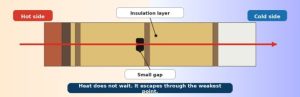
Heat follows the easiest path. A gap becomes that path.
3. Small gap. Big loss.
A small uncovered area can create a much bigger energy penalty. In pipe insulation, gaps making up only about 2% of the total surface can increase heat loss or heat gain by about 40% compared with a continuous system.
Even a small gap can disturb the performance of the whole insulation system
4. Where do thermal shortcuts usually hide?
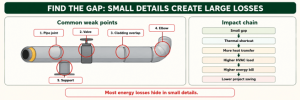
Most defects are found at site details, not at flat straight surfaces. These locations need special attention during installation and inspection.
| · Pipe and duct joints | · Access doors and penetrations |
| · Valves, flanges and bends | · Cladding overlap and vapor-barrier joints |
| · Hangers, supports and brackets | · Damaged or wet insulation zones |
5. Good installation blocks the shortcut
Why the same insulation can fail: performance is not only thermal conductivity, density or thickness. It also depends on tight joints, staggered layers, vapor-barrier continuity, cladding overlap, accessory insulation and moisture protection.
Practical rule: no visible gap, no compression, no open vapor barrier and no unprotected insulation.
Insulation design gives the expected performance.
Installation quality decides whether that performance is actually achieved.
Source notes: 2% gap / ~40% heat-loss increase: Insulation Outlook, “Insights for Insulation Installation.” Roof insulation board gap R-value impact: Molleti & van Reenen, Buildings 2022, 12(1), 68. DOI: 10.3390/buildings12010068.
~ Kinnari Modi
Research Engineer
kinnari@swaconsultancy.com







One thought on “Insulation Efficiency vs Installation Quality – How Gaps Create Thermal Shortcuts”
Viraj Shah
June 17, 2026Wait.. how much %