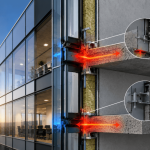
Curtain wall systems are popular in modern buildings for their clean appearance and daylight benefits. However, some parts of the system, such as slab edges and fixing anchors, can become weak points where heat easily passes through the building envelope.
As insulation professionals, we generally focus on wall insulation, roof insulation and thermal performance. Yet, even high performance insulation used there are some heat loss can occur through poorly designed curtain wall interfaces.
This thermal bridges may not be visible during construction, but their effects become evident throughout the building life cycle through higher energy consumption, condensation, occupant discomfort and potential durability during issues.
What is Thermal Bridge?
Thermal Bridge is a location where heat flow more easily through the building envelope due to the presence of highly conductive material.
Common examples include:
- Concreate slab edges
- Steel curtain wall brackets
- Aluminum anchors
- Structure penetrations through insulation
Heat always flows the path of least resistance.
Q = U x A x ΔT
Where:
- Q = Heat transfer rate (W)
- U = Overall heat transfer coefficient (W/m²·K)
- A = Area through which heat flows (m²)
- ΔT = Temperature difference between inside and outside (°C or K)
As thermal bridges, the local U Value become much higher than surrounding insulated areas, resulting in increased heat flow.
Typical Curtain Wall Thermal Bridge Locations:
- Slab Edge Interface
The curtain wall is usually installed outside the concreate floor slab.
Without proper thermal separation, the concrete slab extends from the conditioned interior to the exterior environment.
Example:
Building Location: Mumbai
Indoor Temperature: 24°C
Outdoor Temperature: 40°C
Temperature Difference (ΔT): 16°C
When the concrete floor slab continues from inside the building to the curtain wall area without a thermal break, heat flows directly through the concrete.
Q = U x A x ΔT
Assume:
- Slab edge area = 10 m²
- U-value of exposed slab edge = 3.0 W/m²K
- ΔT = 16°C
Q = 3 × 10 × 16 = 480 W
This means approximately 480 watts of unwanted heat continuously enters the building through only 10 m² of slab edge.
2. Curtain Wall Anchors and Brackets
Curtain walls are supported by steel or aluminum brackets connected to the building structure.
| Material | Thermal Conductivity (W/m·K) |
|---|---|
| Mineral Wool | 0.035 – 0.040 |
| Concrete | 1.5 – 2.0 |
| Steel | 45 – 60 |
| Aluminum | 160 – 220 |
This means aluminum can conduct heat thousands of times than insulation material.
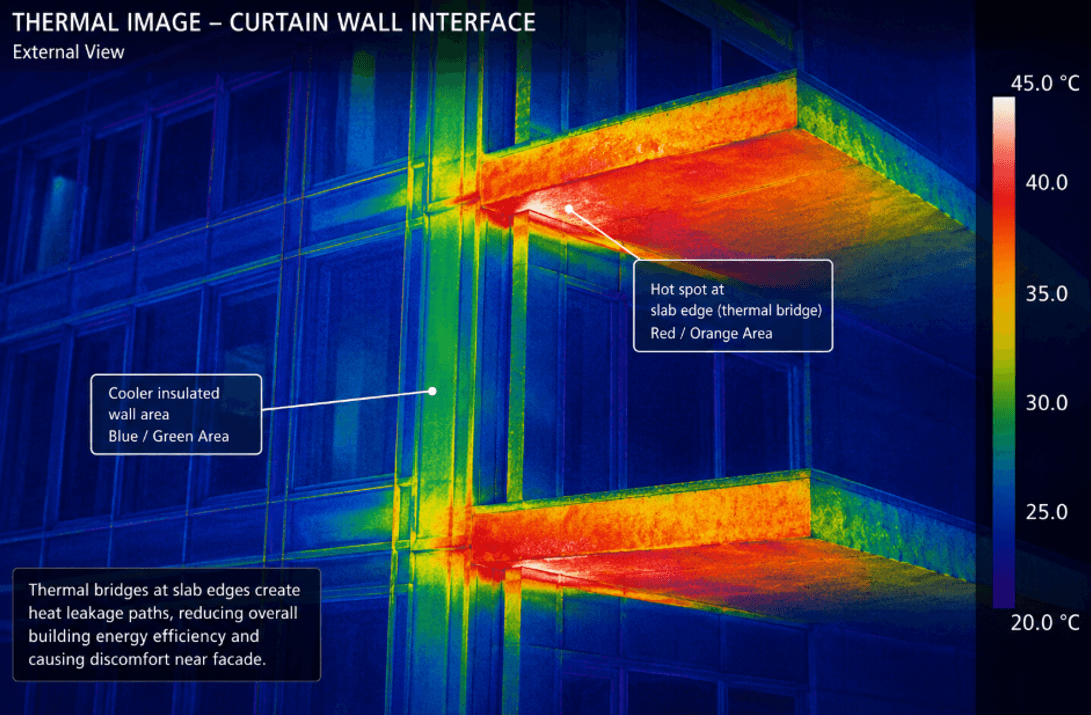
Insulation helps reduce heat transfer and improve building comfort. However, if heat can pass through slab edges, anchors or brackets, the insulation cannot perform intended. It is similar to wearing a warm jacket with an open zipper, the jacket is there, but heat still finds a way through. To get the full benefit of insulation, thermal bridges must also be controlled. When insulation and thermal break solution work together, the building stays more comfortable, uses less energy for cooling or heating, and perform better in the long term.
By Swapnil Pawar
Research Engineer
swapnil@swaconsultancy.com