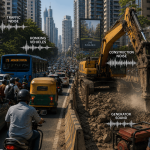
Imagine walking through a bustling metropolis. What do you hear?
For most of us, urban life is defined by a chaotic wall of sound: the roar of combustion engines, the screech of subway brakes, the drone of industrial HVAC units, and the relentless background hum of construction.
For decades, we’ve accepted this sensory overload as the price of living in a thriving economic hub. We tell ourselves that a loud city is a productive city. But there is a massive difference between the vibrancy of human activity and the pollution of mechanical noise.
The goal of a “silent city” isn’t to create an eerie, dead silence. It’s about achieving acoustic balance – protecting the sounds that give a city its soul while filtering out the noise that degrades our health.
The Core Idea: We don’t need to mute our cities. We need to curate them.
- The Invisible Tax on Urban Well-Being
Most city dwellers pride themselves on their ability to “block out“ the chaos. You might stop consciously noticing the traffic horns or the building ventilation systems after a while, but your brain never stops processing them.
Unlike a trash-filled street or a smoggy sky, noise pollution leaves no visible trace. Yet, it operates as a constant, low-grade stressor.
- Cognitive Drain: Continuous environmental noise keeps the human nervous system on mild alert, quietly raising cortisol levels.
- The Masking Effect: Excessive mechanical noise drowns out the very things that make urban spaces feel alive—outdoor conversations, laughter, and local street music.
- Acoustic Fatigue: When a public plaza is too loud, people don’t linger; they escape. Bad acoustics actively kill community spaces.
Noise is the pollution we hear every day, but we rarely see.
- Quiet vs. Dead: Retaining the Urban Energy
When people hear the phrase “quiet city,“ they often picture a sterile, sleepy suburb. They worry that aggressive noise control will sap a city of its cultural identity, energy, and spontaneity.
But true soundscape design doesn’t eliminate life; it reveals it.
When you damp down the oppressive, low-frequency rumble of heavy traffic, something incredible happens: the environment opens up. Suddenly, you can hear the splash of a fountain, the rustle of wind through leaves, footsteps on brick pavements, and vibrant patio chatter.
By engineering out the mechanical noise, we actually amplify the human element.
We aren’t losing the city’s soul; we’re letting it speak.
- The Blueprint for an Acoustically Balanced City
Creating spaces that sound better requires shifting away from reactionary fixes (like ugly concrete highway noise walls) and moving toward proactive, intelligent design.
Modern acoustic planning utilizes a mix of innovative architectural and urban strategies:
- Acoustic Facades: Designing building exteriors with sound-absorbing geometries and materials rather than flat, hard surfaces that bounce noise back into the streets.
- Tactical Greenery: Using strategic urban forestry and living green walls. Soil and leaves don’t just look good; they act like natural sound-scattering diffusers.
- Pedestrian Prioritization: Expanding car-free zones and low-noise public transit corridors to eliminate the primary source of city center rumble.
- Sonic Zoning: Designing layouts that intentionally buffer quiet residential or recreational pockets from high-activity commercial zones.
Every quieter city begins with smarter acoustic design.
- Moving From “Noise Control“ to “Soundscape Design”
The most significant shift in modern urban planning is psychological. Instead of asking a negative question—“How do we block this sound?”—acousticians are asking a positive one:
“What do we want people to hear instead?”
This is the art of Soundscape Design. It recognizes that certain sounds, like moving water or rustling canopy trees, have a psychological “masking“ effect. They don’t just physically soften unwanted background noise; they actively lower human stress levels and make an environment feel calmer than a decibel meter might suggest.
By deliberately introducing pocket parks, architectural water features, and bird-friendly habitats, we can curate an auditory experience that feels restorative rather than exhausting.
The best cities don’t remove sound, they curate it.
From Acoustic Planning to Smarter Living
The cities of the future cannot just be smart; they must be livable. For decades, urban planners have fought against the “Urban Heat Island“ effect, which causes concrete and asphalt to trap solar heat and spike city temperatures. Today, we face an equally exhausting parallel: the creation of the Urban Sonic Island.
Just like heat, ambient noise gets trapped in the hard-surfaced canyons of our streets, echoing off building facades and amplifying industrial rumble until entire neighborhoods become inescapable pockets of sensory overload.
Breaking the Urban Sonic Island effect requires a fundamental shift in how we build. A truly successful city isn’t one that is completely silent, but one that deliberately replaces mechanical chaos with natural acoustics. By engineering spaces that absorb unwanted noise and invite the sounds of life back in, we ensure our expanding cities protect our mental and physical well-being.
The cities of tomorrow are being shaped right now.
It’s time to build urban environments that don’t just look spectacular but also sound spectacular.
Vivek Panchal
Associate Engineer
vivek@swaconsultancy.com