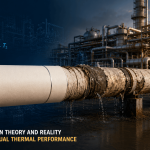
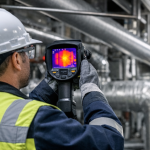
Fourier’s law forms the foundation of thermal insulation design. It describes how heat flows through a material due to a temperature difference. It provides the basis for calculating heat loss from buildings, pipelines, tanks, equipment, and industrial processes. Every insulation thickness calculation, energy model, and thermal performance assessment ultimately traces back to this fundamental principle.
In theory, Fourier’s law enables engineers to accurately predict heat transfer and optimize insulation systems for energy efficiency, process control, and occupant comfort. However, real-world insulation systems rarely operate under ideal conditions. Materials age, moisture penetrates assemblies, thermal bridges develop, and installation quality varies significantly. As a result, on-site thermal performance can differ substantially from design calculations.
Understanding where theory diverges from reality is essential for engineers seeking reliable thermal performance throughout the life of an insulation.
Fourier’s Law:
In its simplest form, Fourier’s law states that heat flows through a material in proportion to the temperature gradient and the material’s thermal conductivity.
Most insulation calculations begin with several simplifying assumptions:
- Steady-state heat transfer
- Homogeneous material properties
- Constant thermal conductivity
- One-dimensional heat flow
- Perfect installation without defects
These assumptions are useful for design calculations, but real insulation systems often violate several of them simultaneously.
Where Theory Breaks on Site
Thermal Conductivity Is Not Constant
A common misconception is that insulation has a single thermal conductivity value. Thermal conductivity (λ) changes with temperature, density, moisture content, and ageing.
For example, the thermal conductivity of mineral wool typically increases with increasing operating temperature. Polyisocyanurate (PIR) and extruded polystyrene (XPS) can experience long-term thermal drift as the insulation within their cellular structure gradually diffuses and is replaced by air. The performance of expanded polystyrene (EPS) is influenced by density and manufacturing quality. Even advanced materials such as aerogels exhibit temperature-dependent behavior. Laboratory values are usually measured under controlled conditions that may differ significantly from actual operating environments.
Moisture
When insulation becomes wet, its thermal resistance can decrease dramatically. Moisture replaces insulating air pockets, creating conductive pathways for heat transfer. This issue is particularly common in: Chilled water piping, Refrigeration systems and Cold storage facilities.
In many cases, moisture-related degradation contributes more to thermal performance loss than ageing of the insulation material itself.
Thermal Bridges and Heat Leakage Paths
Fourier’s law-based calculations often assume a continuous insulation layer. Actual installations contain numerous interruptions. But common thermal bridges include pipe supports, metal fasteners, anchors, pipe hangers and equipment penetration. Heat naturally follows the path of least thermal resistance. Even when most of a system is well insulated, localized conductive pathways can significantly increase overall heat transfer.
Air Leakage and Convection Effects
Fourier’s Law describes conductive heat transfer through a solid. When gaps, cracks, or voids are present due to poor installation, shrinkage, or mechanical damage, convective heat transfer enters the system through a mechanism outside the equation’s scope.
Conclusion
Fourier’s Law remains the crucial starting point for any insulation calculation. But the gap between calculated and actual thermal performance is consistently driven by field realities rather than insulation thickness alone. Successful insulation design, therefore, requires more than applying an equation; it demands a thorough understanding of materials, operating conditions, construction details, and field execution. When theory is combined with practical engineering judgement, insulation systems deliver the energy efficiency and thermal reliability they were designed to achieve.
~Shivam Panchal
shivam@swaconsultancy.com