The Misunderstood Role of Insulation
Thermal insulation resists conductive heat flow through walls, roofs, and floors. By improving the thermal resistance (R-value) and reducing the U-value of building assemblies, insulation limits heat transfer between indoor and outdoor environments.
However, insulation does not stop airflow.
For HVAC systems, that distinction can be costly. A building may be well insulated yet still consume excessive energy if uncontrolled envelope leakage exists through cracks, joints, service penetrations, façade interfaces, and construction gaps.
What Drives Envelope Leakage and Air Leakage?
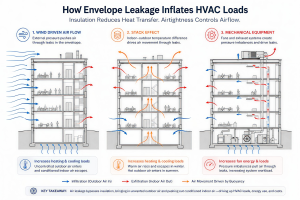
Engineers and building designers commonly identify three driving forces behind uncontrolled air leakage:
- Wind Pressure — external wind creates positive and negative pressure differentials across the building envelope
- Stack Effect — temperature differences between indoors and outdoors drive vertical air movement through the building
- HVAC Systems — pressure imbalances created by supply and exhaust systems draw outside air in through gaps and penetrations
Small Leaks, Big Consequences
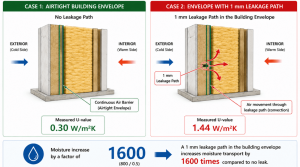
Research by the Fraunhofer Institute for Building Physics found that uncontrolled air leakage reduces the effectiveness of building insulation by a factor of up to 4.8. In other words, a building with uncontrolled envelope leakage requires 4.8 times more energy to heat and cool than one with proper air control.
In practice, inadequate air control leads to:
- Additional sensible loads from unwanted heat gain and heat loss
- Additional latent loads from moisture-laden outdoor air infiltration
- Increased cooling coil and heating coil loads
- Higher ventilation and air distribution energy consumption
- Increased HVAC plant operating costs and peak demand charges
- Reduced overall building energy performance and efficiency
While controlled ventilation remains essential for healthy indoor environments, uncontrolled envelope leakage imposes a significant energy penalty. As unconditioned outdoor air infiltrates the building, HVAC systems must expend additional energy to heat, cool, and dehumidify it before indoor comfort conditions can be maintained. Consequently, the result is increased sensible and latent loads, longer equipment operating hours, higher peak demand, and elevated energy consumption throughout the life of the building.
~Khushi Thapa
khushi@swaconsultancy.com