If you’ve ever noticed moisture forming on chilled-water pipes, AHU lines, or refrigeration lines, you’re witnessing a classic cold insulation failure. And here’s the truth: condensation is not a cooling issue — it’s an insulation issue. Cold insulation isn’t just about keeping things cold; its real purpose is to stop heat and moisture from entering the system. When it fails, the consequences go far beyond surface wetness.
Why Condensation Is a Serious Problem
When warm, humid air contacts a cold pipe surface, moisture condenses. Without adequate cold insulation, this process is continuous. Over time, it leads to corrosion under insulation (CUI), mould growth, increased energy consumption as the system works harder to maintain temperature, and potential structural damage to the surrounding building fabric. In industrial and commercial settings, these failures are both costly and avoidable.
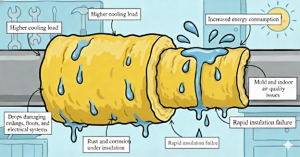
How to Prevent Condensation on Cold Pipes – A Cold Insulation Guide
1. Select the right Insulation material
Best materials for cold applications include:
• Elastomeric foam (NBR, EPDM) – flexible, closed-cell
• PIR / PUF – rigid, low thermal conductivity
• Cross-linked PE foam
• Aerogel composites (premium)
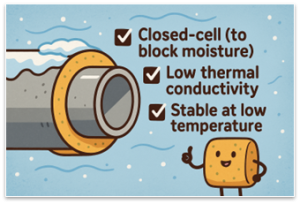
2. Use the correct Insulation thickness
Thickness MUST be enough to maintain:
outer surface > 𝑻dew point
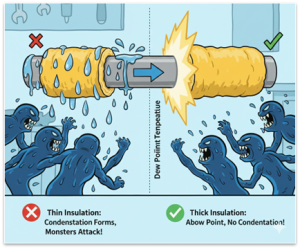
Never guess thickness — always calculate.
3. Apply a proper vapor barrier
The vapor barrier is the heart of a cold insulation system.
It must be:
• Continuous
• Intact
• Properly sealed at all joints and seams
• High vapor resistance
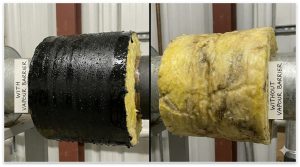
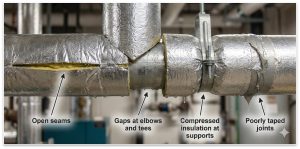
4. Ensure zero gaps, cracks, or compression
Condensation forms at weak points first.
5. Protect Insulation externally
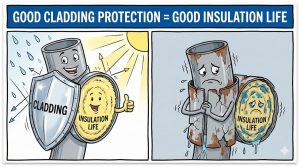
Cladding or jacketing protects cold insulation from:
• Mechanical damage
• Water exposure
• UV degradation (outdoor)
Cold insulation succeeds only when every layer works together. Correct material
selection, accurate thickness calculation, and a continuous vapor barrier form the
backbone of a reliable system.
Any weakness—whether a gap, crack, or damaged cladding—can turn into a condensation
hotspot that compromises performance.
~Khushi