“Small Components, Big Impact: Why Fasteners Matter More Than We Think”
While insulation, glazing, and roofing often receive the most attention in energy-efficient buildings, fasteners are a frequently overlooked source of heat loss and gain. Metal screws, bolts, anchors, and brackets can create direct heat-transfer paths through insulated assemblies, a phenomenon known as thermal bridging. Thermal-break fasteners are designed to interrupt this heat flow and preserve the effectiveness of the insulation system.
The question is: In warm climates, where cooling dominates most of the year, do thermal-break fasteners provide a measurable return on investment (ROI)? The short answer is yes – but only if you know where to deploy them.
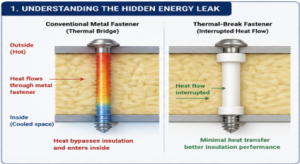
1. Understanding the Hidden Energy Leak
To understand why fasteners matter: stainless steel conducts heat at roughly 15–17 W/mK. PIR insulation conducts it at 0.022 W/mK. That is a 700× gap. Mineral wool is even worse at 1,400× — the oft-quoted “1,500 times” figure simply depends on which insulation you compare against.
When a steel fastener penetrates a 75 mm PIR panel, it short-circuits the insulation entirely. At a modest ΔT of 20°C, a single M10 stainless anchor conducts 0.8–1.2 W continuously. Multiply that across 300 fasteners on a 500 m² wall and your chiller is silently handling an extra 240–360 W it was never designed for.
ISO 10211:2017 quantifies this as point thermal transmittance (χ-value) typically 0.01 to 0.08 W/K per fastener. Across a large facade, that is not a rounding error. It is a measurable degradation of your wall’s effective U-value.
2. Why Warm Climates Face a Different and Underappreciated Problem
The assumption that thermal breaks are only relevant in cold climates is incorrect. In warm, humid regions, heat flows inward rather than outward, but thermal bridges still provide a direct path for heat transfer.
Consider a pharmaceutical cleanroom in Ahmedabad maintained at 22°C and 50% RH while the external façade reaches 55°C under solar exposure. The indoor dew point is approximately 11°C. In such environments, thermal bridges can create localized temperature gradients that shift the dew-point location into the wall assembly, increasing the risk of concealed condensation around structural penetrations and vapor-barrier discontinuities.
While this may result in minor staining in a conventional office, in cleanrooms, pharmaceutical facilities, and food-processing plants it can lead to moisture damage, microbial growth, product contamination, and regulatory non-compliance. This is why ECBC and NBC emphasize envelope continuity and moisture-management principles, both of which can be compromised by poorly designed thermal bridges.
3. The ROI Question: Answered with Numbers
Modern thermal-break systems use engineered polymers, glass-fiber reinforced composites, and other low-conductivity materials that typically exhibit thermal conductivities between 0.1 and 0.5 W/mK significantly lower than stainless steel. The thermal conductivity of these materials is 40 to 150 times lower than stainless steel. This is not a marginal improvement.
Worked Example Industrial Cold Store, Ahmedabad:
Wall assembly: 100 mm PIR panel (λ = 0.022 W/mK), 200 fasteners over 800 m² facade, outdoor peak 44°C, interior maintained at 4°C (ΔT = 40°C). Assume each conventional stainless M10 anchor has a χ-value of 0.04 W/K (typical per ISO 10211). Additional heat gain from fasteners = 200 × 0.04 × 40 = 320 W continuous. Over 18 hours of peak cooling per day: 320 W × 18 h = 5.76 kWh/day, or approximately 2,100 kWh/year.
Switching to composite thermal-break anchors reduces the χ-value to approximately 0.005 W/K. Revised heat gain = 200 × 0.005 × 40 = 40 W. Annual saving ≈ 1,875 kWh. At ₹8/kWh, that is ₹15,000/year in avoided electricity cost from fasteners alone, before accounting for reduced compressor wear or improved temperature stability.
Premium thermal-break fasteners cost roughly ₹200–400 more per point than conventional equivalents. For 200 fasteners, the additional capital cost is ₹40,000–80,000. Simple payback of 3–5 years on a facility with a 20–30 year operational life is a rational investment by any standard. For a pharmaceutical facility where condensation avoidance prevents even one batch rejection or one compliance audit failure, the payback is measured in months, not years.
4. Where Thermal-Break Fasteners Deliver the Highest Value
Not every project requires thermal-break fasteners throughout the building envelope. The strongest ROI is achieved where temperature differentials are high and the consequences of thermal bridging are significant, such as:
- Cold stores and cold-chain facilities
- Pharmaceutical manufacturing and storage
- Cleanrooms and datacentres
- Museums and archives
- High-performance buildings targeting LEED, GRIHA, or ECBC+ certification
For standard commercial offices and low-rise buildings with modest cooling loads, thermal-break fasteners are beneficial but the energy payback extends to 8–12 years. The targeted approach — deploying them only at high-conductivity junction points such as roof-to-wall interfaces, structural brackets, and panel seams — delivers the best cost-to-performance ratio on these projects.
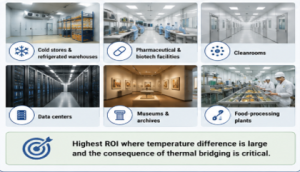
The greatest return is achieved where temperature control and energy efficiency are mission-critical.
From Fasteners to a Quantifiable Decision
Thermal-break fasteners can deliver measurable ROI in warm climates, particularly in cold stores, pharmaceutical facilities, and cleanrooms where temperature control is critical. The combination of reduced heat gain, lower cooling loads, and minimized condensation risk often justifies the investment.
For conventional commercial buildings, the benefits should be evaluated on a case-by-case basis using thermal bridge analysis rather than applied universally. Ultimately, insulation performance depends on the entire building envelope, and properly addressing thermal bridges is essential to achieving genuine energy efficiency.
~ Lakshya Vaishnav
Associate Engineer
lakshya@swaconsultancy.com