If you’ve ever noticed moisture forming on chilled-water pipes, AHU lines, or
refrigeration lines, you’re witnessing a classic cold-insulation failure.
And here’s the truth:
Condensation is not a cooling issue — it’s an Insulation issue
Cold insulation isn’t just about keeping things cold; its real purpose is to stop heat and
moisture from entering the system.
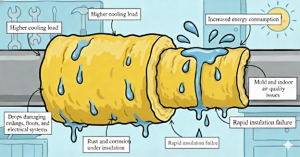
Why Condensation Is a Serious Problem!!
How to Prevent Condensation on Cold Pipes??
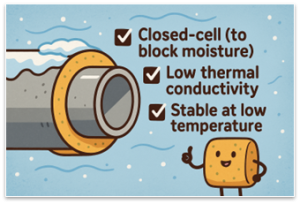
1. Select the right Insulation material
Best materials for cold applications include:
• Elastomeric foam (NBR, EPDM) – flexible, closed-cell
• PIR / PUF – rigid, low thermal conductivity
• Cross-linked PE foam
• Aerogel composites (premium)
2. Use the correct Insulation thickness
Thickness MUST be enough to maintain:
outer surface > 𝑻dew point
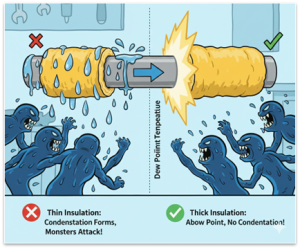
Never guess thickness — always calculate.
3. Apply a proper vapor barrier
The vapor barrier is the heart of a cold insulation system.
It must be:
• Continuous
• Intact
• Properly sealed at all joints and seams
• High vapor resistance
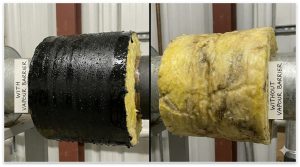
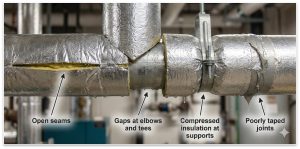
4. Ensure zero gaps, cracks, or compression
Condensation forms at weak points first.
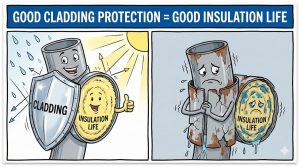
5. Protect Insulation externally
Cladding or jacketing protects cold insulation from:
• Mechanical damage
• Water exposure
• UV degradation (outdoor)
Cold insulation succeeds only when every layer works together. Correct material
selection, accurate thickness calculation, and a continuous vapor barrier form the
backbone of a reliable system.
Any weakness—whether a gap, crack, or damaged cladding—can turn into a condensation
hotspot that compromises performance.
~Khushi