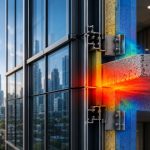
When Fire Testing Relied Only on Experiments
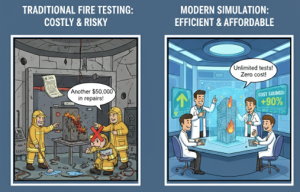
Before simulation tools existed, understanding fire meant physically creating one. Engineers had to design and build dedicated test setups. Fire testing was not just about gathering data, it was equally about managing risk in a live fire environment.
The Challenge of Predicting Fire in Real Buildings
As buildings became more complex, engineers started asking more what-if questions than experiments could realistically answer.
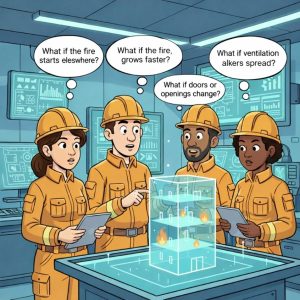
Fire Dynamics Simulator (FDS): Bringing Fire into the Digital World
Developed by the National Institute of Standards and Technology (NIST), FDS allows engineers to simulate how fire, ventilation, and smoke behave within a space without having to ignite a real fire, it uses computational models grounded in fire science to recreate fire-driven flows in three dimensions.
The following are a few representative scenarios where FDS simulations are used:
- Visualizing how smoke layers form and move within space
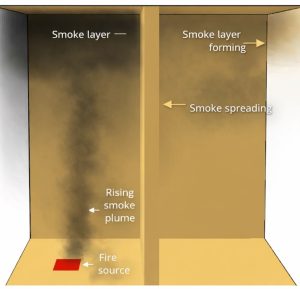
- Temperature build-up near ceilings, walls, and other surfaces
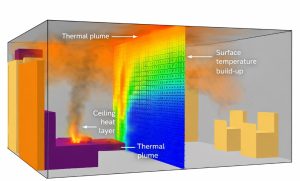
- Assessing the impact of ventilation and openings on fire and smoke spread over time.
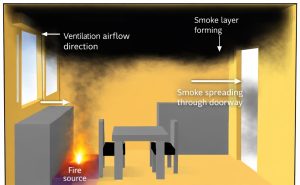
- Exploring multiple fire scenarios safely and repeatedly, without the cost and risk of physical tests
Extending Fire Knowledge Through FDS
FDS does not replace fire testing, it builds on it. The knowledge gained from decades of experiments forms the foundation of the models used in FDS, allowing engineers to extend real-world fire behavior to complex building geometries. By bringing fire into the digital world, FDS enables engineers to ask critical what-if questions early in the design process long before a fire ever occurs.
~Khushi Thapa