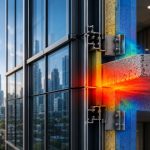
Fire is fundamentally unpredictable, and no two fire events behave the same way. design. The spread of any fire is dictated by four critical variables: fuel load, ventilation, geometry, and how smoke travels through a building.
Understanding these factors is the first step in moving from a reactive mindset to a resilient one.
The Anatomy of Fire Spread
A building’s layout and contents dictate its fire profile. Fuel load determines the energy available, while the geometry and ventilation paths act as the “engine” that drives heat and flames through the structure.

The High-Rise Challenge: Ventilation, Stack Effect & Smoke
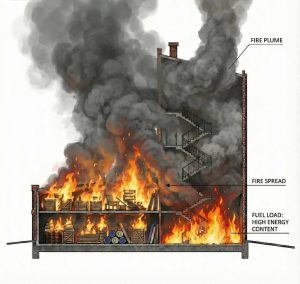
In tall structures, the danger scales significantly. Smoke movement is often more lethal than the flames themselves, driven by complex ventilation paths and the stack effect.
In many high-rise incidents, occupants lose precious evacuation time not because the fire reaches them, but because smoke fills corridors and staircases first. This creates a “zero-visibility” environment that makes escape routes unsafe and slows down emergency responders
Passive Fire Protection: The Silent Shield
This is where Passive Fire Protection (PFP) becomes the building’s silent shield. Built into the structure itself, PFP ensures that even when fire and smoke behave unpredictably, the building continues to provide time for evacuation and survival.
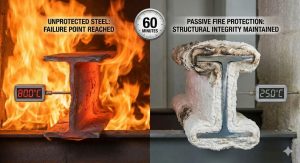
At the core of this system is passive fire insulation. During a fire, the greatest risk is the rapid rise in temperature. As structural steel heats up, it loses strength, if heat transfers through walls or shafts, compartments fail and smoke spreads across multiple floors.
Passive fire insulation slows this process by:
- Delaying heat transfer.
- Reducing structural temperature rise.
- Containing the fire’s effects.
- Protecting escape routes.
The True Cost of Safety
Passive fire protection doesn’t need to “activate” – it is already working the moment a fire begins. It is a proactive investment in human life and structural integrity.
“If you think safety is expensive – try an accident” – Dr. Trevor Kletz’s
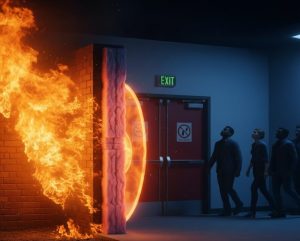
Passive fire insulation is not just a construction specification, it is the shield that holds the fire back, buys precious minutes, and helps prevent a fire incident from becoming a life-threatening disaster.
~Khushi Thapa